

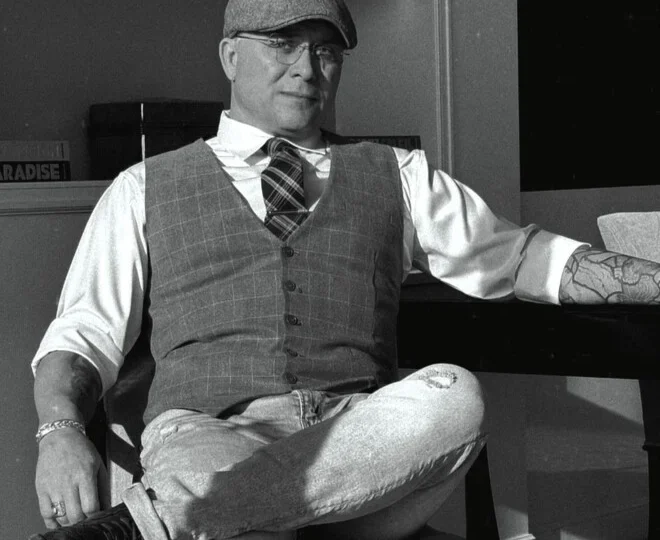
By Steffon Olsen
To say Justin Hunt is an innovative, dark horse filmmaker would be an understatement. Hunt is one of the most celebrated writer/producer/directors of our age. His films have been distributed in over 100 countries. He is fearless in his unrelenting passion to take on some of the most important and plaguing social issues of our day. White Whale Pictures, Inc., his production company, has become one of the hottest brands in the industry. As a journalist early in his career, Justin won over 40 broadcasting awards. Hunt has since won over 100 film festival trophies worldwide with his films and screenplays. He’s produced seven feature films, including ‘Rotten Apple’, which has garnered several ‘Best Documentary’ and ‘Best Director’ awards and nominations.
Scorpius Magazine was thrilled to recently enjoy the honor and privilege of interviewing Justin Hunt.
Scorpius: What was your life like in early childhood and what were the most powerful movie and television influences during that era that may have inclined you to gravitate towards the path that led you to become a broadcast journalist and filmmaker?
Hunt: My early life was extremely unique and nomadic. I grew up in a family in the world of horse racing, which was a fascinating landscape and we moved around a lot. Both of my parents are in the Hall of Fame for, so our family was quite popular everywhere we went, and that led to a lot of rare experiences. As far as movies and TV shows, I recall several of the old TV shows like Hill Street Blues, The Rockford Files and Barney Miller, which were full of a creative mixture of drama and humor. A few films that stuck with me from my youth are Watership Down, Jeremiah Johnson, Butch Cassidy and The Sundance Kid and Cool Hand Luke. Those had an impact.
Scorpius: What was it like being raised by horse racing professionals?
Hunt: It was definitely an abnormal childhood. I saw a lot of things that kids shouldn’t see, but it was pretty cool having parents that entire communities came out to see when we would come to town. However, there was a dark underbelly to it all that exposed me to a lot of the uglier side of life at an early age.
Scorpius: Who were the most influential directors and documentary filmmakers for you?
Hunt: To be honest, I don’t really have any documentary directors that I model myself after, although I do appreciate the work of Tiller Russel (Nightstalker). In terms of narratives, directors that I consider to be inspiring to my work are John Ford, The Coen brothers, Stanley Kubrick, David Fincher, Paul Thomas Anderson, Quentin Tarantino, George Roy Hill, John Hughes and Steven Spielberg.
Scorpius: What was life like as a broadcast journalist for an NBC affiliate and what was the hardest story you had to report?
Hunt: I loved being a journalist. I enjoyed being ‘inside the ropes’, so to speak, as well as dealing with the community and being the first to know when something happened. There are too many stories to name that were difficult, but seeing innumerable dead bodies, families dealing with tragedy, things of that nature were never fun. On the other hand, there were also stories that had a happy ending that made it worthwhile.
Scorpius: What was the most rewarding aspect of being a broadcast journalist?
Hunt: I think being a source of credibility for the community, the person they count on to know what’s happening in their environment, was probably the most rewarding. Having people approach you and tell you they appreciate what you do and how well you do it. That always feels affirming when you’re trying to do a good job.
Scorpius: Would you tell us a little about each of the films you produced, maybe a memorable moment from each and which was your personal favorite to work on? Army Men, American Meth, the Speed of Orange, Far Too Far, Addicted To Porn: Chasing the Cardboard Butterfly, the Post.
Hunt: That’s a very broad question, but I can tell you that they were all very difficult to produce, but they were all extremely rewarding because of how they affected people’s lives. Touring various countries with the films and seeing how they impacted different people in different ways. Talking to them and hearing their stories and how the films helped them to deal with certain issues in their lives.
Scorpius: What was it like to work with James Hetfield?
Hunt: As a kid that grew up listening to Metallica, seeing them as bigger than life, it was pretty surreal, at first, to be in their world and to work with Het. But, as we got to know each other, the wow factor wore off and we just became two men that each had our own life issues and we discussed those as friends. It was also challenging because working with James is not the same as working with Metallica. His involvement was personal and not tied to the band, so the weight of their popularity didn’t really play a part in the exposure of the two films we did together. I’m grateful for the experience and his being part of the films.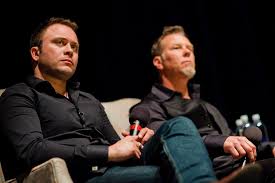
Scorpius: What is the most rewarding aspect of your work and what drives you emotionally and creatively as a producer/filmmaker?
Hunt: There are a lot of things that I find rewarding. The creative process, working with people that I love and respect, seeing the finished product and the impact it has on audiences around the world. In terms of the documentaries, I enjoy seeing them being used to change and improve people’s lives. As for the narratives, it’s always a surreal experience to see something that started out as a spark of an idea in my mind make it through the entire creative process to a theater full of people. That’s extremely rewarding.
Scorpius: Is there an wild, or poignant experience you may recall, during the production of one of your films that made a major impact on you and your perspective?
Hunt: There are tons of them. I would have to say living with the meth addicts (for American Meth) and seeing that kind of existence first hand was an eye opener. On the narrative side, being able to direct really great actors who bring your words to life is something I’ll never grow tired of. Directing Val Kilmer was also a singular experience.
Scorpius: What can you tell us regarding any future projects you are currently engaged in?
Hunt: I have several in the works, both in film and television, that I’m working to get funded and produced. As I get older, I feel a pull to focus more on the writing, but you never know where life is going to take you, so I just try to be open to whatever presents itself.
Scorpius: Would you ever consider directing a major motion picture if you were approached by a major studio?
Hunt: Absolutely. Step two is getting that call.
Scorpius: If today were the last day of your life, what wisdom or thought would you leave the world?
Hunt: That, no matter what kind of work you’re in or just living life, in general, being honest and authentic with people, ALL people, will get you farther than anything else you can do. It’s not hard to take the shady route, to hurt others to get what you want, to be dishonest, but that’s not the kind of legacy I want to leave on a professional level. And it sure as hell isn’t the kind of mark I want to leave as an example for my children.
