

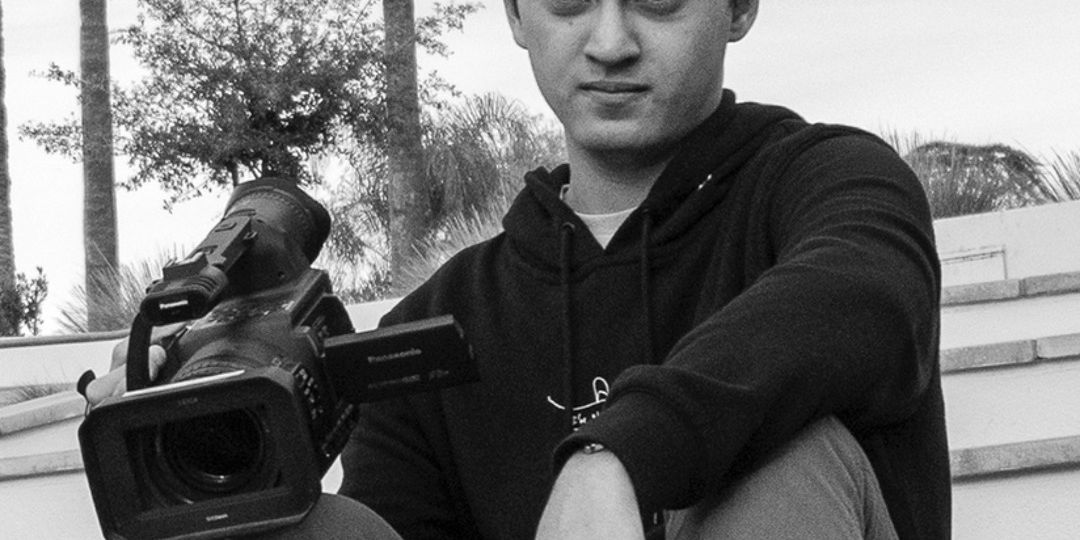
By Steffon Olsen
Jakob Rippe discovered his affinity for filmmaking as a child growing up in Southern California. As an aspiring young filmmaker, he created content for brands such as Bell helmets, Sony Music, and Porsche North America. He has also worked with multi-platinum record producer Kiddominant. With ten short films under his belt, he has currently been surfing the film festival circuit with his latest film, ‘One for the Road,’ which was a huge hit with audiences at Scorpiusfest 2026 in Boulder, Colorado.
Scorpius: When did you realize you wanted to become a filmmaker, and what movies and directors were the most influential on you, from an early age?
Rippe: I knew from a very young age, probably four or five, that I enjoyed making videos and showing them to friends and family. I was also obsessed with the gear used when making movies, seeing the water towers when we would drive down the freeway in Burbank, or meeting anyone from television (especially newscasters) in person. Oddly enough, I feel that despite my past and current work, filmmaking is an ever-elusive dream that I will continue to chase. I know I’m doing it, but I rarely FEEL like I’m doing it. The movies that inspired me as a kid range from Pixar’s Cars to That Thing You Do! By Tom Hanks. Those were (and still are) two comfort movies that bring together my love of 50s-60s design with a heartfelt connection between characters. One director who has always been impactful to me is the late John Hughes. His way of capturing life, especially during those transitional teenage years, is something that will always feel timeless and relatable to many. His humor and writing style captivated me from the first scene and left a lasting desire to rewatch his works over and over again.
Scorpius: What are some impressionable experiences early on in your life that had a powerful impact on you as a storyteller?
Rippe: I’m not sure what the experiences were, but I know they are there. There are strong themes of longing for connection, struggling with loss, and fear of the unknown throughout my work, yet I can’t seem to place any specific impactful moments that would have caused such a traumatic response. It could be a subconscious reaction to the world around me, as I’m always observing my surroundings and absorbing energy near me. I’m an empath. It could also be a culmination of events that, while small individually, created patterns early on in my mind. On the more uplifting side of this, I do know that my ventures into storytelling came from a place of wanting to explore the world and other people’s experiences in it. Storytelling has always been a way to have fun and build experiences, regardless of where I am or who I’m with. A crucial factor for this is being an only child with a busy mind that was always running at full speed when I was little.
Scorpius: What can you tell us about the first film you made when you were six years old?
Rippe: That takes me back! It was called “Year by Year” and was more or less a collection of home videos I made that aimed to show what childhood was like as a kid growing up in Orange County, California, in the early 2000s. My parents were very trusting and let me use the family camcorder to film myself doing all kinds of goofy things. Was there any storyline? No. Did any of the segments make sense to anyone besides me? Also no. A few of my friends from school thought it would be cool to “make a movie” and wanted to pitch in too. We had dreams of a major premiere. One friend even learned to use WordArt to make tickets. Hahaha! Fast forward about a year and a half later I made my first real short. It was about a farmer, a werewolf, and a maiden in distress. I had wanted to make a fun movie for Halloween, so my dad and I wrote a short story. When it came time to film, my dad worked the camera and editing software, I played the farmer and werewolf, and my mom played the maiden in distress. It actually came out pretty good, considering how archaic the editing software was in those days. It took a couple of hours to export the four-minute video in 480p!
Scorpius: Which film that you have produced would you consider your personal favorite and why? Some memorable experiences while producing it?
Rippe: I’ve had fun with just about every project I’ve produced, but my favorite probably has to be a short called “Anniversary”. The story itself is tragic- a man falls asleep at the wheel, resulting in a crash that kills his fiancée on their anniversary. He has to live with the grief of knowing that his action, while an accident, took the love of his life. The “anniversary” now plays a painful juxtaposition to the pure joy of being in love and the harsh emotions behind an abrupt loss. The reason this film was my favorite to produce came from the circumstances behind making it. I was in my senior year of college, and this was my thesis film. It also happened to be April 2020… in the midst of the global pandemic. I shot almost everything myself, which forced me to think creatively. I wanted a thesis film to be proud of, so I didn’t compromise with lighting, sound, or camera movements. I would set up a scene by tearing apart a room in my house, decorating the set so that it would fit the character, prop a boom pole overhead using lighting stands, and adjust the balance on the tripod to get gravity to gradually tilt the camera, creating motion. I had one scene that required a prop to land a specific way. After a few attempts, it was clear that getting this effect naturally was going to be virtually impossible. I reconfigured the prop to increase the weight on one side so it would fall perfectly with every take. I also experimented with green screen and chaser tube lighting to create a moving picture car in my backyard. It was far from perfect, but I created something that would have been impossible without perseverance and creativity. When I first sent the script to my professor, she asked how many people I expected to have on my crew and how I intended to film it during the pandemic. I smiled, naively, I may add, and said I planned on filming it all myself and told her some of the tricks I was going to use to bring my vision to life. She wished me well, but strongly advised that I choose an easier story to tell. I’m glad I was stubborn and stuck to my initial plan.
Scorpius: What is your favorite aspect of cinematography, and who have been some of the most influential cinematographers in your life?
Rippe: A few cinematographers that come to mind right off the bat are Linus Sandgren, Robert Richardson, and Roger Deakins. Linus has such a unique way of pushing the boundaries of what cinematography can be with camera movements, especially his practical transitions that create beautifully complex motions (Check out his work in the behind-the-scenes documentary of Jay Kelly to see how complex these motions can get). I am a huge fan of collaborative work between a director and their cinematographer. Linus’s work with Damien Chazelle in La La Land and Babylon are great examples of how two creative minds can flow into a gorgeous final result. Robert Richardson is also a great example of how a cinematographer and director can work well together. His work with Quentin Tarantino is proof that collaborative effort is the best superpower for pushing the limits of art and creative expression. Roger Deakins’s work is simply gorgeous. I don’t know how else to describe it. 1917, Shawshank Redemption, and Fargo – these are just a few examples of how cinematography can truly inspire me. I’m also a huge fan of directors who aren’t afraid to grab a camera and shoot their own films. Steven Soderbergh, Robert Rodriguez, and early Quentin Tarantino films are next-level inspiration to me because they prove that a kid with a camera and a dream can create stunning films that captivate audiences and launch careers.
Scorpius: What did you like best about your experience at ScorpiusFest?
Rippe: Everything was great. I don’t know if I can pick one specific thing that stood out above the rest. The staff were all super friendly, the discussion panels were helpful and interactive, and the filmmakers and their projects represented a wide range of genres, styles, and themes. Put all of that in an awesome venue in beautiful Boulder, Colorado, and you have a winner! This was my first time in Boulder, and I absolutely fell in love with the small-town charm. One of the things I loved was that it was a small enough festival that everyone was approachable, but large enough that every screening was virtually sold out. I haven’t experienced that degree of audience interaction and filmmaker involvement in any other festival I have attended. It was such an exciting feeling, the buzz of the crowd during Q&As after each screening, and getting to meet and talk with the filmmakers following each film block. Lots of great networking with filmmakers from across the country all weekend long. I’m already making plans to attend next year’s festival!
Scorpius: What can you tell us about any future projects that may be in the works?
Rippe: I don’t currently have a project in production or post, but I do have a few projects nearing pre-production. I am always writing and love to bounce ideas around with fellow writers and directors. I hope to direct a short this summer with some friends; we have a few ideas for stories that we would like to create. One of the cool things about my passion for writing is that I’m never far from a story that we can turn into a film! I really do need to get back out there, though, and produce more of my own projects. Lately, I have been working a lot on client projects, which has been great, but nothing compares to making my own films with my friends!
Scorpius: Is there a dream project that you may have always wanted to direct?
Rippe: I have several. There’s a list of actors, composers, and cinematographers that I would love to work with. I could probably take up a whole separate interview on who that is and why I chose each artist on that list. In terms of projects as a whole, there are two main ones in mind. One is a period piece set in the 1920’s about a mob family. I don’t currently have a full story or script in the works, but I do often find myself worldbuilding the city, characters, and motivations behind their crimes. The second project is much less complex, but would still be a challenging task in its own right. It’s an action film that honors my great aunt and uncle, who lived in San Clemente during the rise of surf culture. I have an outline for the story, but I want to dive in (pun intended) a bit more before really getting into the writing process. It would be set in the present day, but talk about the lifestyle and mentality that came to be during this pivotal time in Southern California culture.
Scorpius: Is there a particular muse or driving force behind your work as a filmmaker, and what is it?
Rippe: One particular muse? No, I don’t think so. I take inspiration from the world around me, and my mind is always running with ideas of “what if this?” or “how about that?” Inspiration comes from music, the news, people watching, personal experiences, and even other films. I think from a more technical standpoint, I push through moments of professional challenges to be a role model to my younger self and pursue goals that I have dreamt about since I was a child. From a director’s perspective, once I’m heading into pre-production, my driving force is to create an environment where the cast, crew, and anyone who may be impacted by our shenanigans feels informed and respected. I want to prepare enough on the front end that everyone who works with me feels confident in the project and can be proud of the work we do as a team. It’s never been “look, I’m the director, I’m in charge” to me. Yes, I have to take control and make decisions that affect everyone on set, but I am always willing to collaborate, hear differing ideas, and admit when I’m wrong or when someone has a better way of doing something. That, to me, is when the best art is made.
Scorpius: If you could leave one word of advice for younger filmmakers, from your experience, what would it be?
Rippe: Fascination. That’s the one word of advice. The longer explanation behind that is to try your hardest to keep that eager spark that excites young children with nearly everything in their lives. Keep that sense of wonder, hope, and optimism about the world and the people you meet. Things can be scary; it can be so easy to fall into anger, fear, or loneliness, but try to fight those negative feelings. Keeping an open mind to the places I’ve traveled, people I’ve met, or experiences I’ve had has really allowed me to view the world in multiple perspectives- and that is crucial to the creative process. From there, if there’s something specific that interests you, chase that dream. Whether it’s filmmaking, music, writing, restoring cars, playing a sport, cooking… ANYTHING you enjoy doing is worth doing, even if others don’t like your style or you aren’t recognized for your talents. It doesn’t always have to be your career, either. I’ve known too many colleagues who have forced themselves on a steep, slippery slope to making a career out of their hobbies until they experience massive burnout. It’s okay to do something for the love of doing it; not everything has to be for profit. As long as you keep that fascination, hold onto an open-minded sense of wonder, and pursue your passions, you’ll live a pretty satisfied life.
