

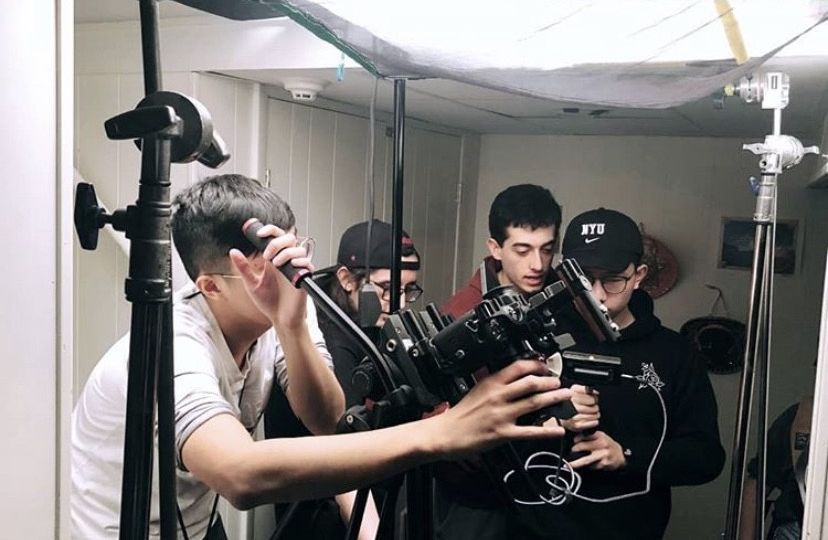
By Steffon Olsen
Ryan Russo began his inspired journey as an independent filmmaker from the origin of visual storytelling. He has since garnered multiple awards from around the world for his exceptional films as well as gained international recognition for his innovative filmmaking prowess. His recent film, ‘Boiling Point’ is stirring conversations among audiences and filmmakers throughout the industry.
Scorpius: When did you realize you wanted to become a filmmaker and what movies and directors were the most influential on you, from an early age?
Russo: It’s hard to pinpoint a single moment, it was more of a slow realization. I grew up obsessed with practical special effects and history. I’d spend hours trying to recreate things I saw on screen, whether it was the mechanics of a gunshot effect or the details of a historically accurate uniform from a period film. That curiosity was really my first entry point into filmmaking. I was also watching films at a pretty young age that I didn’t fully understand yet, but that almost made the experience more impactful. I wasn’t focused on the plot as much as I was on the atmosphere and immersive setting. I became especially drawn to period pieces, drawing inspiration from directors like David Lean, Sergio Leone, and George Roy Hill. Films like Barry Lyndon, Doctor Zhivago, and The Sting really struck a chord with me. What stayed with me wasn’t just the storytelling, but the visual language and the attention to detail. Seeing shots and sets that felt like they were drawn directly out of a painting was something that completely stopped me in my tracks. That sense of visual storytelling has stayed with me ever since and continues to be a major source of inspiration in my own filmmaking.
Scorpius: What are some impressionable experiences early on in your life which had a powerful impact on you as a storyteller?
Russo: Some of the most formative experiences for me early on weren’t tied to a single moment, but rather to repeated exposure to stories and worlds that felt completely different from my own. I never really felt particularly connected to the modern world or contemporary films, so I naturally gravitated toward stories set in other times as a form of comfort and escape. A lot of that was shaped at home as well. My Dad would often have mob films playing, and I would watch them with him, taking in those worlds without fully understanding everything at the time. My Mom, on the other hand, would put on English period pieces, which further deepened that fascination with history and distant eras. My Mom was a painter, and she always made a point of taking me to art museums and galleries wherever we went. She continually encouraged my creative interests, and those experiences definitely played a big role in shaping the filmmaker I’ve become today. I think that early exposure to visual art is still at the core of how I approach filmmaking. In every film I direct, I try to emulate a certain painting within a frame, whether that’s through composition or production design. For example, the opening shot of Boiling Point was directly inspired by Gennady Dobrov’s Farewell Glance. That kind of reference point helps me ground a scene visually and emotionally, and it’s something I continue to draw from in my work.
Scorpius: Where did the inspiration come from for “Boiling Point”?
Russo: Boiling Point started as a joke in passing I had with a friend about how ridiculous the concept of cockfighting is, and how it could become even more ridiculous. That conversation slowly evolved from aggressive betta fish, to crabs, and eventually, after someone in a bar drunkenly told me crabs were “too pedestrian,” I landed on lobsters. Watching films by Chaplin, Keaton, and Chaney really inspired me to challenge myself and the team to rethink the approach entirely. What had initially been written as a contemporary piece gradually shifted into a silent, period-inspired film. Telling this absurd story through the language of silent cinema felt like a way to heighten both the humor and the challenge. It allowed the story to lean even further into its own strangeness, while also pushing us creatively in terms of performance and visual storytelling.
Scorpius: Which film that you have produced, would you consider your personal favorite and why? Some memorable experiences while producing it?
Russo: In all honesty, Boiling Point! It was the first film I made since high school, and the entire experience from pre-production through post was truly unforgettable. I had a great cast and crew, many of whom were friends and family, and I honestly couldn’t have asked for a better set experience. That being said, there were plenty of memorable moments along the way. After writing the script, we struggled to find a location that fit my vision. After exhausting most of our leads, my location scout and I reached out to a local fire chief in Sedalia, Colorado, to see if he knew of any spaces with a large, open interior suitable for the ring. He ended up taking us to a Christian youth retreat where he served as a caretaker. What made it especially strange was the history of the property. Before being converted into a retreat, the site had been owned in the 1920s by Diamond Jack Alterie, a hitman for the North Side Gang, rival of Al Capone’s Chicago Outfit. After being exiled from the gang, he relocated to Colorado and allegedly ran an illegal gambling hall and brothel out of that very building. It felt almost serendipitous that we were making a short film about an illegal gambling hall set in the same era, in a space that had once functioned in an eerily similar way. That connection ended up becoming one of the most memorable and unexpected parts of the entire process.
Scorpius: What is your favorite aspect of being a director and storyteller?
Russo: My favorite aspect of being a director and storyteller is the ability to build immersive visual worlds, especially when working within different time periods. I’ve always been drawn to visual storytelling and the idea that so much of a story can be communicated through composition, production design, and atmosphere before a single line of dialogue is spoken. There’s something really powerful about trying to transport an audience completely into another era that I strive to emulate when directing or writing. I love the process of researching, designing, and shaping every detail so that it all feels cohesive and lived-in. That kind of immersion is what excites me most about filmmaking.
Scorpius: What aspect did you enjoy the most regarding your experience at Scorpiusfest?
Russo: What I enjoyed most was the exchange of perspectives. Being in a room with both international and local filmmakers created this constant exchange and dialogue. I ended up having some really memorable conversations with a group from Great Britain after their film, and it was equally exciting to discover and connect with local filmmakers I hadn’t encountered before and would love to work with in the future. The entire event was put on wonderfully and I’m hoping that we’ll have something ready to submit for next year!
Scorpius: What can you tell us about any future projects which may be in the works?
Russo: We’re currently in production on a WWII psychological thriller titled Charcoal. It follows a young American GI in the aftermath of the Battle of the Bulge, as isolation and trauma begin to fracture his sense of reality after he becomes the sole survivor of his squad. This is a massive project that I’ve been working on for about 6 years, I’m very much looking forward to sharing it with the world and hopefully submitting to the next Scorpiusfest.
